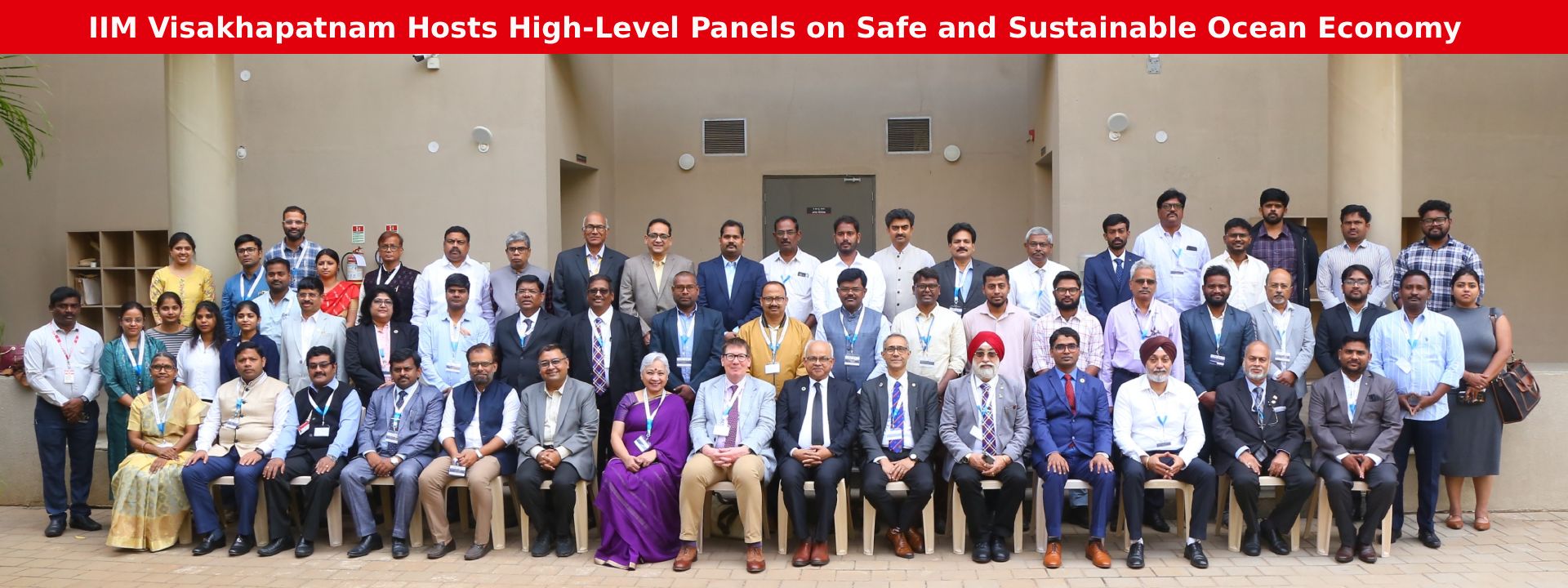
IIM Visakhapatnam Hosts High-Level Panels on Safe and Sustainable Ocean Economy
Visakhapatnam, January 12, 2026: The Indian Institute of Management Visakhapatnam hosted the fifth national workshop of Ocean Centres India, a long-term initiative under the United Nations Global Compact and supported by the Lloyd’s Register Foundation. The workshop leveraged IIM Visakhapatnam’s strategic coastal location and its growing intellectual engagement with maritime and sustainability issues. The strategic partners for the initiative are the Ministry of Earth Sciences and the Directorate General of Shipping.
The Ocean Centres initiative has been established across seven countries, Brazil, Ghana, Kenya, India, Bangladesh, Indonesia, and the Philippines, with the objective of placing safety at the core of sustainability in the ocean economy. The workshop at IIMV was organised around the theme “Stepping Stone Towards a Safe and Sustainable Ocean Economy in India.”
The programme commenced with an inaugural session featuring senior policymakers and sector leaders. Dr Ravi Raj Atrey, Country Lead, Ocean Centres India, noted that eight closed-group multi-stakeholder workshops are being conducted across key maritime locations including Kochi, Mumbai, Chennai, Bhubaneswar, Visakhapatnam, Mangaluru, Panaji, and Kolkata.
Ms Uma Sudhindra, Member, Board of Governors, IIM Visakhapatnam, emphasised the role of the ocean as a lifeline for energy, food, technology, and trade. She underscored the growing importance of maritime cybersecurity and highlighted the need for a dedicated maritime cybersecurity framework, technology hardening, human capital development, and regional cooperation.
Capt V. Pardhasaradhi, Deputy Nautical Adviser-cum-Senior Deputy Director General (Technical), Directorate General of Shipping, Ministry of Ports, Shipping and Waterways, address covered India’s Panchamrit Action Plan, Green Shipping Initiatives, the Swachh Sagar Portal, the National Green Shipping Policy, the Ship Recycling Portal, and the Ship Recycling Credit Note.
Addressing the gathering, Mr Alex Stitt, Director, Heritage and Education Centre, Lloyd’s Register Foundation, stated that the initiative would later enter Assessment and Actions phase, which will translate the current stakeholder deliberations into practical and actionable pathways to strengthen safety and sustainability across India’s ocean economy.
The first panel discussion on “Port Security: Issues and Challenges in India” was moderated by Prof Amit B. Chakrabarti, Associate Professor (Strategy) and Head, Centre for Responsible Management Education, IIM Visakhapatnam. The second panel on “Demand and Supply Gaps in Blue Finance and Investment in India” was moderated by Prof Md Shameem Jawed, Associate Professor (Finance and Accounting), IIM Visakhapatnam.
The discussions highlighted key issues related to trade facilitation and protection of economic hubs, technological integration and surveillance, logistics infrastructure and regulatory frameworks, national security and risk assessment, regional cooperation and geopolitics, institutional frameworks and inter-agency coordination, and community engagement, capacity building, and livelihoods protection. The deliberations also underscored the importance of maintaining investor confidence while accelerating India’s transition to a safe and sustainable ocean economy.
In addition, the workshop examined national priorities, strategies, frameworks, and regulations; the role of environmental, social, and governance (ESG) considerations in attracting blue investment; risk mitigation and emerging opportunities; tools and frameworks in blue finance including the Ocean Investment Protocol 2025; sub-sector-specific gaps in blue finance and investment in India; and potential financing solutions for the blue economy. These insights were presented by Mr Ratnesh, Executive Director, United Nations Global Compact India, during the valedictory session.
Given that India’s blue economy accounts for nearly 95 percent of trade by volume and 70 percent by value, the workshop reinforced the critical role of coordinated policy, finance, and institutional mechanisms. The initiative at IIM Visakhapatnam is anchored by the Centre for Responsible Management Education, which continues to advance research, dialogue, and action on sustainable economic practices.

.jpg)